
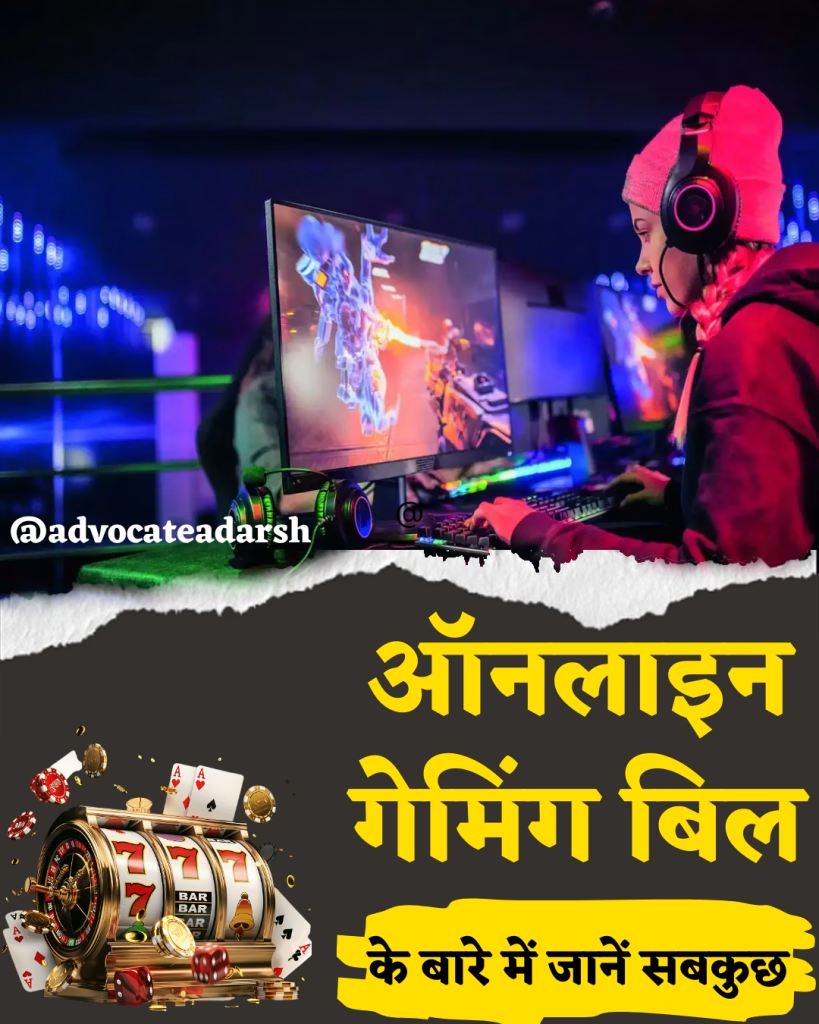
IIndia’s online gaming sector has exploded over the last few years. From casual puzzles on smartphones to immersive e‑sports tournaments with professional teams, digital games are now part of daily life for hundreds of millions of people. With this growth have come concerns about unregulated money games, addictive designs and financial losses. In August 2025 the Union government introduced the Promotion and Regulation of Online Gaming Bill, 2025 in the Lok Sabha. The bill – which has already cleared the lower house – attempts to strike a delicate balance between nurturing innovative gaming industries and protecting citizens from harm.
What the bill aims to achieve
The bill is designed to create a national‑level framework for online gaming. It has two broad goals:
- Promote and regulate legitimate games. E‑sports, educational games and social gaming are recognised as legitimate recreational activities. The government is empowered to develop guidelines, training academies and technology platforms to support these sectors. E‑sports are defined as multiplayer competitions governed by pre‑defined rules where outcomes are determined by physical dexterity, mental agility or strategy. Social games are those offered solely for entertainment, recreation or skill development.
- Prohibit and penalise online money games. An online money game is any game where players pay money, credits or tokens in the hope of winning a monetary reward. The bill forbids offering, aiding, advertising or even facilitating financial transactions for such games. Banks and payment processors would be barred from processing these transactions.
Prohibition on online money games
The bill’s most debated provision is its outright ban on real‑money online games. It defines an online money game as any digital contest where users pay fees, deposits or stakes expecting monetary or other enrichment. The ban covers both skill‑based and chance‑based games and includes virtual credits or tokens convertible to cash. Key aspects include:
- No offering or facilitation. Individuals or companies cannot offer or facilitate online money games or related services. Even aiding or abetting such games is prohibited.
- No advertisements or endorsements. Advertising money games across TV, print, digital media or via celebrities and influencers is banned. Violations may lead to up to two years in jail and fines of up to ₹50 lakh.
- Harsh penalties. Operating or facilitating money games can attract imprisonment of up to three years and fines up to ₹1 crore. Repeat offenders face even higher penalties, with imprisonment extending to five years and fines up to ₹2 crore.
- Financial restrictions. Banks and financial institutions cannot process transactions for prohibited games. Authorities can block information related to money‑gaming services.
These prohibitions reflect official concern that real‑money platforms have led to social, economic and mental‑health harms. Government sources cited cases where people “lost their life’s savings”, noting that the design of such games is often “addictive and manipulative”. A Times of India report summarised the official view that the proliferation of money games “has led to serious social, financial, psychological and public health harms, particularly among young individuals and economically disadvantaged groups”.
Promoting e‑sports, educational and social games
Rather than tarring all gaming with the same brush, the bill tries to cultivate a vibrant, legitimate gaming ecosystem:
- Formal recognition of e‑sports. E‑sports are acknowledged as a competitive sport. The legislation envisions official guidelines, training academies and technology platforms under the Ministry of Youth Affairs and Sports. Provisions also encourage the organisation of events and tournaments to nurture talent.
- Encouragement of educational and social games. The government can register games deemed safe and age‑appropriate and support the development of educational, cultural and skill‑oriented titles. Awareness campaigns will highlight the positive uses of gaming and promote digital literacy.
- Policy support and infrastructure. Ministries such as Youth Affairs & Sports, Electronics & IT (MeitY) and Information & Broadcasting will collaborate to align India’s gaming landscape with global standards. Incentives may include grants for technology platforms, scholarships for players and tax breaks for game developers.
A National Gaming Authority
Central to the bill is the creation of an Authority on Online Gaming. This body will determine whether a game qualifies as a money game, recognise and categorise games, register operators and issue guidelines. The Authority will handle complaints and enforce compliance. According to the financial memorandum, the regulator will require roughly ₹50 crore in initial capital and ₹20 crore annually from the Consolidated Fund of India. The government argues that this investment will provide long‑term oversight and unify a currently fragmented regulatory environment.
Search, arrest and enforcement powers
To enforce the bans, authorised officers are empowered to search and seize both physical and digital spaces without a warrant. Officers may enter buildings, vehicles or even virtual digital spaces such as email accounts and social media to gather evidence. They can arrest suspects found during the search. Offences related to offering money games and facilitating their transactions are cognisable and non‑bailable.
Why the bill matters
The government’s rationale is that money‑based online gaming has outpaced state regulations and created significant public‑policy challenges. Communications and IT Minister Ashwini Vaishnaw told Parliament that India’s online ecosystem has grown exponentially, producing both harmless casual games and high‑risk money games. He warned that the latter are harming families, leading to addiction, financial losses and even suicides, and posing threats like money laundering and terror funding. In this light, the bill aims to protect vulnerable groups while allowing healthy forms of digital play to flourish. Some commentators see the legislation as a decisive break from years of “grey zone” state‑level regulation and a move toward a unified national policy.
Industry reaction: applause and anxiety
The e‑sports and casual gaming sectors largely welcome the bill’s recognition and support. Gaming industry leaders say that officially distinguishing e‑sports from gambling “safeguards the integrity of our ecosystem while opening doors for structured growth”. They emphasise the need for clear and consistent definitions to give players, teams and investors confidence. Many hope that government‑backed academies, infrastructure and scholarships will help India compete internationally.
Real‑money gaming firms, however, warn of severe economic consequences. Industry associations have claimed that a blanket ban could destroy over 2 lakh jobs and force 400 companies to shut down, driving consumers to unregulated offshore operators. Shares of listed gaming firms fell sharply after the bill’s introduction. Critics argue that the bill conflates games of skill with gambling and that outright prohibition could spur underground activity rather than eliminating harm.
The road ahead
The Promotion and Regulation of Online Gaming Bill, 2025 still awaits scrutiny in the Rajya Sabha and potential amendments. Even after passage, detailed rules will be needed to clarify definitions, licensing procedures, taxation and grievance redressal mechanisms. Stakeholders from game developers to civil‑society groups are urging the government to consult widely and ensure that regulation is nuanced rather than blunt.
Nevertheless, the bill marks a watershed moment for India’s digital entertainment industry. By recognising e‑sports as a legitimate sport, encouraging educational and social games and addressing the harms of money‑based gaming, the legislation seeks to shape a safer and more innovative gaming ecosystem. How effectively it balances these twin goals of promotion and protection will determine whether India becomes a global powerhouse in e‑sports or whether players migrate to offshore platforms. As the debates continue, gamers and policymakers alike will be watching closely.
Download the draft
If you’d like to read the full text of the Promotion and Regulation of Online Gaming Bill, 2025, you can download the draft from www.advocateadarsh.com